# Exploring the Molecular Properties of GHK-Cu
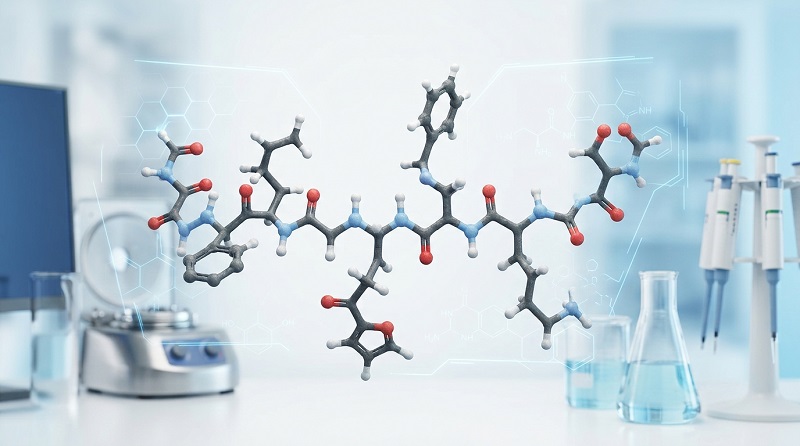
GHK-Cu is a small copper-binding peptide that has attracted interest in scientific and biotechnology research. It is made from three amino acids, glycine, histidine, and lysine, and it can form a complex with copper ions. Because of this structure, researchers study GHK-Cu to better understand how small peptides interact with metals and biological systems. Its simple molecular design makes it an interesting subject for laboratory research.
The molecular structure of GHK-Cu is important because it contains chemical groups that can interact with copper. The peptide sequence provides binding sites that help hold the copper ion in a stable complex. This copper-binding ability is one of the main properties that separates GHK-Cu from many other short peptides. Researchers examine these interactions to understand how the peptide behaves under different laboratory conditions.
Copper is an important trace element involved in many biological processes. It can take part in reactions connected with enzymes, proteins, and cellular systems. However, free copper ions can also participate in unwanted chemical reactions when their levels are not controlled. The ability of GHK to bind copper has therefore become an important area of molecular research. Scientists investigate how this interaction may influence the chemical behavior of both the peptide and the metal.
Another interesting property of GHK-Cu is its relatively small molecular size. Small peptides are useful in research because their structures can be studied more easily than larger proteins. Scientists can examine their amino acid sequence, charge, stability, and interactions with other molecules. These studies can help researchers understand how changes in peptide structure may affect molecular behavior.
The chemical environment can also influence the behavior of GHK-Cu. Factors such as pH, temperature, copper availability, and surrounding molecules may affect its stability and interactions. Laboratory researchers can change these conditions to observe how the peptide responds. Such experiments are useful for building a clearer picture of its molecular characteristics and for understanding how peptide-metal complexes behave.
GHK-Cu has also received attention because of research into its possible relationship with biological processes. Scientists have investigated its interactions with cells and biological molecules in different experimental settings. These studies are still important because laboratory observations need to be carefully separated from proven clinical effects. Research on a peptide can provide useful scientific information without automatically proving that it is an effective treatment for a particular condition.
Modern peptide research often combines chemistry, molecular biology, and biotechnology. Researchers may use analytical methods to examine peptide purity, molecular weight, structure, and stability. These methods help confirm what a peptide contains and how it behaves during experiments. For GHK-Cu, understanding the copper-peptide relationship is especially important because the metal component is closely connected to its molecular identity.
Quality and consistency are also important when studying peptides. A research sample must have a well-defined composition so that scientists can trust their experimental results. Differences in purity, storage conditions, or preparation can affect laboratory observations. This is why researchers pay close attention to analytical testing and controlled experimental conditions when working with peptide materials. Organizations and suppliers working with research peptides, including c<a href="https://www.chppeptide.com">chp champion peptides</a>, may focus on clear product information and quality standards to support responsible laboratory work.
GHK-Cu is also interesting because it demonstrates how a very small molecular structure can have complex chemical behavior. Its three-amino-acid sequence may appear simple, but its ability to interact with copper creates several questions for researchers. Scientists can study its binding behavior, stability, molecular interactions, and responses to different environments to learn more about peptide chemistry.
As biotechnology continues to develop, research into small peptides remains an active scientific area. GHK-Cu provides an example of how researchers can study the relationship between peptide structure and metal ions. Continued laboratory investigation may provide more information about its chemical properties and biological interactions. For now, its value in research comes from the opportunity to explore peptide-metal chemistry and better understand how molecular structure influences behavior in controlled scientific environments.